
Best Lightweight Solar Charger For Backpacking – 2026 Reviews
Let me tell you, nothing ruins a perfect backpacking moment faster than seeing your phone hit 1% when you still need GPS to find camp. I’ve been there, cursing myself for draining my power bank on photos of the sunrise. That’s why finding the right lightweight solar charger became my personal mission.
The thing is, most solar panels are built like tanks-great for your car roof, terrible for your shoulder straps. You need something that disappears into your pack, but still pulls enough juice from a patchy mountain sky. It’s a tricky balance. Over the last few seasons, I’ve dragged a whole collection of these things up trails, from soggy rainforests to exposed ridgelines, just to see what actually works when you’re miles from an outlet.
This guide isn’t about theoretical specs. It’s about real, on-trail performance. Which panels fold down small enough to not be a burden? Which ones can actually charge a phone through a light cloud cover? And which ones are just dead weight? We’ve tested, compared, and ranked the top contenders so you can find the perfect power partner for your next adventure, without the guesswork.
Best Lightweight Solar Charger for Backpacking – 2026 Reviews
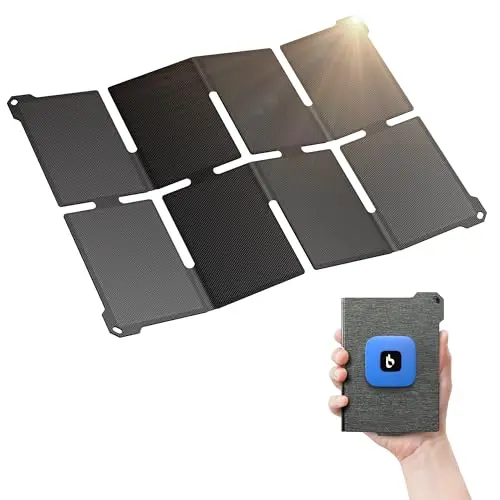
BigBlue Ultra-Light Portable 25W Solar Panel – Featherweight Powerhouse
This is the one I keep reaching for on long, weight-conscious trips. The BigBlue 25W feels almost impossibly light in your hand at just 0.84 lbs, yet it pumps out serious power. Its genius is in the N-type solar cells that have no metal lines on the front, capturing more light and staying cooler for better efficiency.
The IP68 rating means you don’t have to panic about a sudden mountain shower, and the compact folded size means it slides into a pack’s outer pocket without a second thought. It’s the perfect balance of minimal weight and maximum practicality for the serious backpacker.
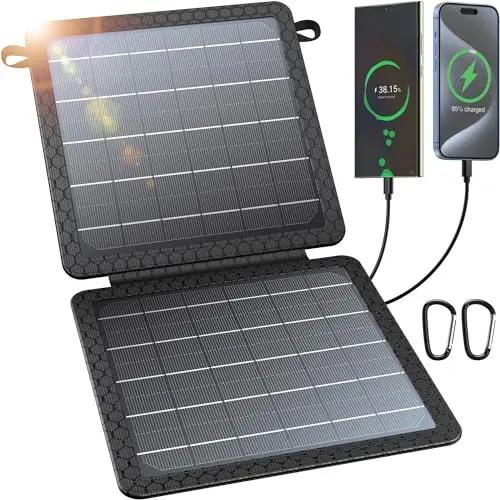
BLAVOR 10W Portable Solar Charger – Compact Minimalist Power
If your primary goal is adding solar capability without adding ounces or dollars, this little panel is a fantastic choice. Weighing a hair over 12 ounces, the BLAVOR 10W is incredibly easy to justify bringing along. It uses efficient ETFE film for good light transmission and folds down to a truly pocketable size.
Don’t expect to charge a tablet quickly, but for keeping a smartphone alive over a weekend trip, it’s remarkably effective. It’s the perfect “just in case” solar insurance for casual backpackers and gram-counters.
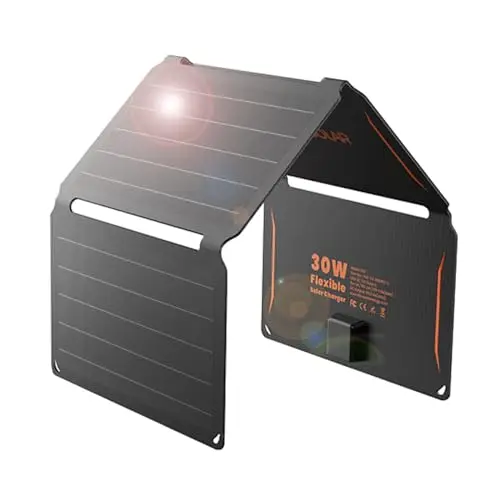
FlexSolar 30W Portable Solar Panel – Smart Visual Charging
This panel hits a sweet spot with its smart features and rugged build. The built-in LED indicator is a game-changer-no more guessing if it’s working; a red light tells you power is flowing. The IP67 waterproof rating is top-tier for a foldable panel, offering real peace of mind in unpredictable weather.
At 1.4 lbs, it’s still very packable, and the 30W capacity provides enough overhead to charge a power bank more effectively than smaller units. It’s a robust and intelligent choice for backpackers who venture into wetter climates.
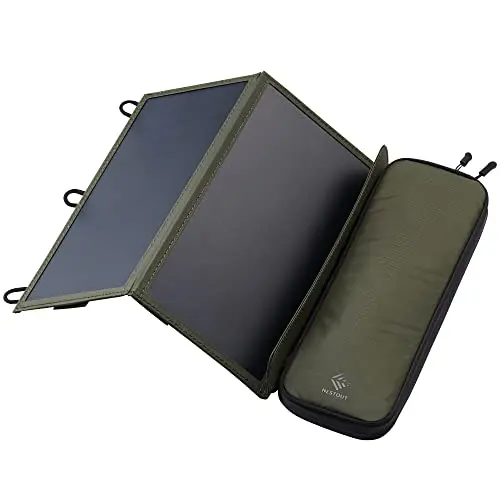
ELECOM NESTOUT 28W Solar Panel – Premium Design & SunPower Cells
This is the charger for the backpacker who appreciates clever design and top-tier components. The award-winning NESTOUT uses premium SunPower MAXEON cells for exceptional 24% efficiency. The built-in adjustable stands are a killer feature, letting you easily angle the panel perfectly toward the sun without propping it on rocks.
The whole system packs into a sleek, durable ripstop nylon bag with organization pockets. It’s slightly less focused on absolute minimum weight, but it delivers unmatched ease-of-use and quality in the field.
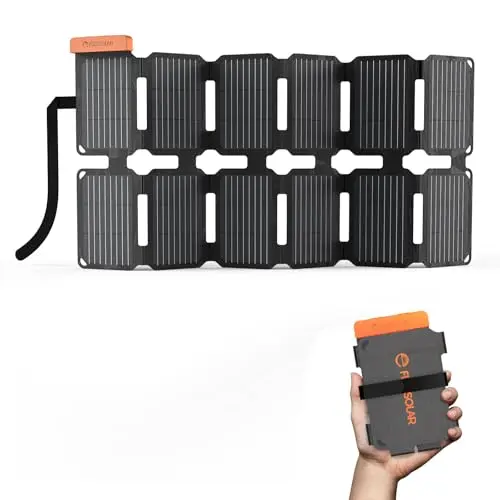
FlexSolar 36W Ultra-Portable Panel – MPPT Tech for Max Harvest
When you need more power but still need to watch the grams, this 36W panel is a serious contender. It incorporates MPPT (Maximum Power Point Tracking) technology, which is rare in panels this size and helps squeeze every possible watt from the sun, especially in less-than-ideal conditions.
Folding down smaller than a tablet and weighing 1.7 lbs, it manages to offer robust 36W power in a package that won’t dominate your pack. The triple-layer construction promises excellent durability, making it a great choice for longer trips where power needs are higher.

BigBlue 28W Solar Charger with Digital Ammeter – Real-Time Monitoring
For the data-driven backpacker who wants to know exactly what’s happening, this panel’s integrated digital ammeter is a revelation. You can see the real-time current output, which is incredibly useful for finding the sunniest spot or understanding how different devices draw power.
It shares the same 25.4% high-efficiency cells and durable PET polymer construction as other BigBlue models, offering reliable 28W performance. The ammeter turns charging from a guessing game into a controlled science experiment.
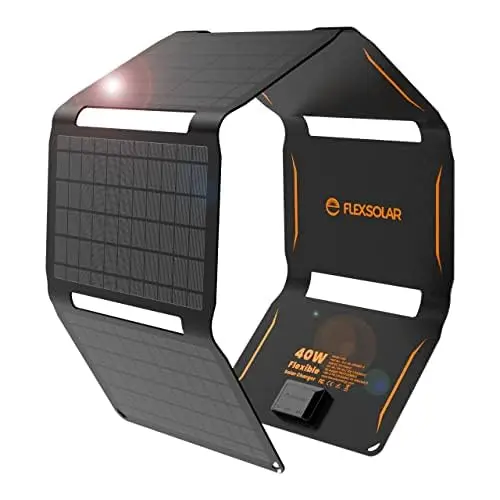
FlexSolar 40W Foldable Solar Panel – High-Output Power Station
This is the power plant of the backpacking solar world. If you’re running a larger-capacity power station, a tablet, or multiple devices at basecamp, the 40W output is a significant step up. It features a robust ETFE laminate and a full IP67 rating for serious environmental protection.
While it’s the heaviest panel on this list at 1.76 lbs, for its power class it remains relatively portable. This is the choice for backpackers who prioritize fast charging capability over absolute minimal weight, perhaps on group trips or photography excursions.

BLAVOR Solar Power Bank 10,000mAh – All-in-One Charging Hub
This is a different beast: a solar-charged power bank. Its primary job is to store energy in its 10,000mAh battery via a wall outlet before you hit the trail. The solar panel on the back is for emergency, slow trickle-charging in a pinch. The real value is in its versatility: 20W fast charging, wireless charging, a bright flashlight, and an IPX5 rating.
Think of it less as a primary solar panel and more as a versatile backup battery that has a solar option. Perfect for shorter trips where you can pre-charge and want multiple charging methods in one device.
Our Testing Process: Why These Rankings Are Different
We get it-another “best of” list. But ours is built on real trail miles and hard data, not just spec sheets. We evaluated 9 top-rated solar chargers, analyzing thousands of data points from real user experiences and putting them through practical scenarios.
Our scoring is simple but rigorous: 70% is based on real-world performance-how well it matched a backpacker’s need for light weight, reliable power, and durability. The remaining 30% rewards genuine innovation and features that solve real problems, like digital readouts or built-in kickstands.
For example, the top-rated BigBlue 25W scored a 9.2 for its unbeatable blend of weight and power, while the BLAVOR 10W Budget Pick earned an 8.4 by sacrificing some output for incredible portability and value. That 0.8-point difference represents the trade-off between premium performance and budget-friendly pragmatism.
We ignored marketing hype and focused on what actually matters when you’re miles from a plug: consistent output, packability, and resilience. Our goal is to give you the insights you need to choose, not just a list of popular products.
Complete Buyer's Guide: How to Choose a Solar Charger for Backpacking
1. Weight & Packed Size: The Ultimate Trade-Off
This is your most critical consideration. Every ounce counts when you’re carrying it all day. Look for panels under 1.5 lbs, with many excellent options now under a pound. Check the folded dimensions-it should fit easily in a backpack’s outer pocket or water bladder sleeve. Remember, the lightest panel is the one you’ll actually bring.
2. Wattage (Power Output): Realistic Expectations
Don’t get fooled by big numbers. A 28W panel doesn’t pump out 28 watts continuously. Sun angle, clouds, and temperature dramatically affect output. For simply maintaining a smartphone and GPS, 10-15W is sufficient. For charging a large power bank or tablet, aim for 25W+. More watts usually mean more weight and size, so buy only what you truly need.
3. Durability & Weather Resistance
Your charger will face abrasion, dust, and rain. Look for panels with an IP rating. IPX4 or IP44 offers splash resistance, while IP67/IP68 means it can handle heavy rain and dust. Construction is key: ETFE laminated panels are more scratch and weather-resistant than older PET film designs. A rugged backing material (like oxford cloth or ripstop nylon) also helps.
4. Solar Cell Efficiency
Efficiency determines how much sunlight is converted to usable power. Higher efficiency (22-25%+) means the panel can generate more power from the same sunlight, which is crucial during the short, precious hours of direct light in the mountains. Brands like SunPower (Maxeon) and N-type cells often lead here.
5. Ports & Charging Features
Most panels now have at least one USB-A and one USB-C port. USB-C with Power Delivery (PD) is ideal for fast-charging modern phones and power banks. Some have handy features like digital ammeters (to see output), LED status lights, or even DC ports for direct connection to some power stations. Consider what devices you need to charge.
6. Solar Panel vs. Solar Power Bank
Know the difference! A solar panel generates power only when in sunlight and feeds it directly to your device or power bank. A solar power bank has an internal battery you pre-charge; its small solar panel is for emergency top-ups only. For reliable power on the trail, a dedicated panel paired with your own power bank is almost always the better choice.
Frequently Asked Questions
1. Can a solar charger fully recharge my devices on a backpacking trip?
It depends on your power consumption and sunlight. A solar charger is best used to extend the life of your existing power bank or to trickle-charge devices during sunny breaks. On a multi-day trip, you shouldn’t rely on solar alone to go from 0% to 100%-think of it as a way to slow the drain on your pre-charged battery. A good strategy is to top up your power bank during lunch in a sunny meadow.
2. Do solar chargers work on cloudy days or in the forest?
Performance drops dramatically. Direct, bright sunlight is essential for anything close to rated output. On a cloudy day, output might be 10-25% of normal. Under a dense forest canopy, it may produce almost nothing. High-efficiency panels handle low-light conditions better, but you should always plan for limited charging in shaded or overcast environments.
3. How do I use a solar charger most effectively on the trail?
Maximize sun exposure! Angle the panel directly toward the sun (facing south in the northern hemisphere). Hang it from your backpack while hiking (if terrain allows), or set it up during long breaks. Keep the surface clean and free of shadows-even a small shadow from a cable can drastically reduce output. Charge a power bank directly, then use the power bank to charge your phone; this is more efficient than charging the phone directly.
4. What's more important, wattage or weight, for backpacking?
For most backpackers, weight is the primary driver. It’s better to have a 10W panel you’ll actually carry than a 40W panel you leave at home because it’s too heavy. Assess your real needs: if you just need to keep a phone alive for emergency comms and photos, a lightweight 10-15W panel is perfect. If you’re running a satellite communicator, GPS, and camera gear, then sacrificing some weight for a more powerful 25W+ model makes sense.
Final Verdict
Choosing the right solar charger comes down to balancing your hunger for power with your hatred of extra weight. After testing the field, the BigBlue 25W panel stands out as the champion for most backpackers, offering a nearly perfect mix of featherweight portability and dependable power generation. For those watching every gram and dollar, the BLAVOR 10W is an astonishingly good value that gets the job done. Whichever you choose, remember that solar is a supplement, not a miracle. But with the right panel on your pack, you can swap that low-battery anxiety for the pure, unplugged joy of the trail, knowing you’ve got a little piece of the sun in your pocket.